Sewage treatment plant installation
A sewage treatment plant cleans your waste water to a standard that can go to a flowing stream or a drainage field. We size it properly, install it, wire it up through a registered electrician, and hand you the paperwork.
- Plant only
- about £2,000 to £5,000 for a house-sized unit
- Installed
- typically £7,000 to £15,000
- Standard
- BS EN 12566-3 plants
- Servicing
- Plans available after install
What a treatment plant does
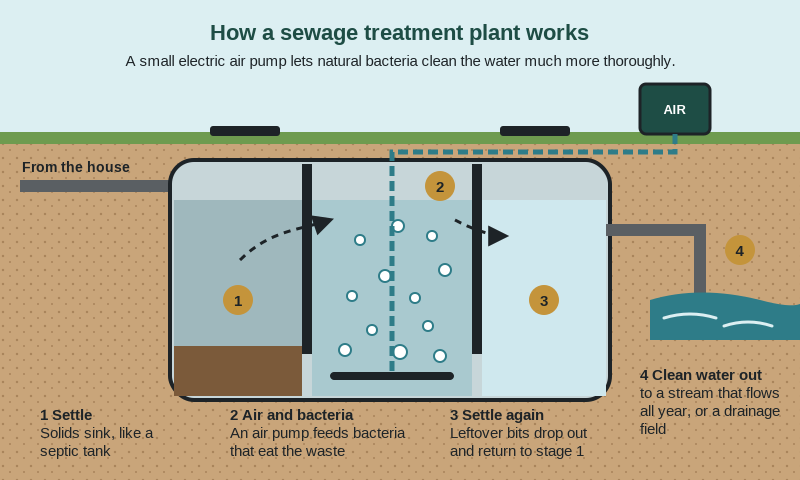
A septic tank only lets solids settle out. The liquid that leaves it is still dirty, which is why it must go into a drainage field to be cleaned by the soil.
A sewage treatment plant goes further. It settles the solids, then pumps air through the liquid so bacteria can break down the waste, then settles it again. The water that comes out is far cleaner. That is why a treatment plant can discharge to a flowing watercourse under the general binding rules, where a septic tank cannot.
The trade-off: a plant needs electricity, a yearly service, and regular emptying. Read septic tank vs treatment plant for the full comparison.
Getting the size right
Plants are sized by "population equivalent" (PE), roughly how many people they can serve. The general binding rules say new systems must be sized to British Water's Flows and Loads guidance, which is based on bedrooms, not on how many people live there today. A typical three bedroom house needs about a 5 or 6 PE plant.
Undersized plants are one of the most common faults we see. They work for a while, then struggle when the house is full or a new owner moves in.
Brands we can fit
We are not tied to one manufacturer. We choose the plant to suit your site, budget and running costs. Makes commonly fitted in the UK include Kingspan Klargester, Marsh, Tricel, Graf, WPL and Premier Tech. Every plant we fit meets BS EN 12566-3. See how to choose a treatment plant.
Where the treated water goes
- To a flowing watercourse. Allowed for a treatment plant (not a septic tank) if the stream flows all year round, the volume is under 5,000 litres a day, and it is not in or near certain protected sites.
- To a drainage field. Needed if there is no suitable watercourse. The ground must pass a percolation test. See drainage fields.
- Pumped. If the outfall is uphill, the plant can include a pump chamber.
What is included
- Site survey, design and plant sizing
- Building regulations application and inspections
- Emptying and removing or filling the old tank (by a registered waste carrier)
- Excavation, installation, backfill and connections
- Power supply and control panel, by a Part P registered electrician
- Commissioning and testing
- Maintenance notice and a handover pack for your records and any future sale
Common questions
How much electricity does a treatment plant use?
It depends on the make and process. Most domestic plants run an air pump or motor all the time, so ask for the running cost of each option. We include this when we compare plants for you.
What happens in a power cut?
Approved Document H says a plant that needs power should be able to work without it for up to 6 hours, or have a backup supply. Plants still hold the waste in a power cut. Tell us if your area has long outages and we will factor it in.
How often does a treatment plant need emptying?
The general binding rules say at least once a year, or as the manufacturer says. See our guide on how often to empty a treatment plant.
Can I install a treatment plant myself?
It is possible but not something we would recommend. It needs building regulations approval, correct sizing, safe deep excavation, and electrical work by a registered electrician.
Get a fixed, written quote
Free site visit across Wells and an hour around. We tell you straight what you need, what it costs and how long it takes.